
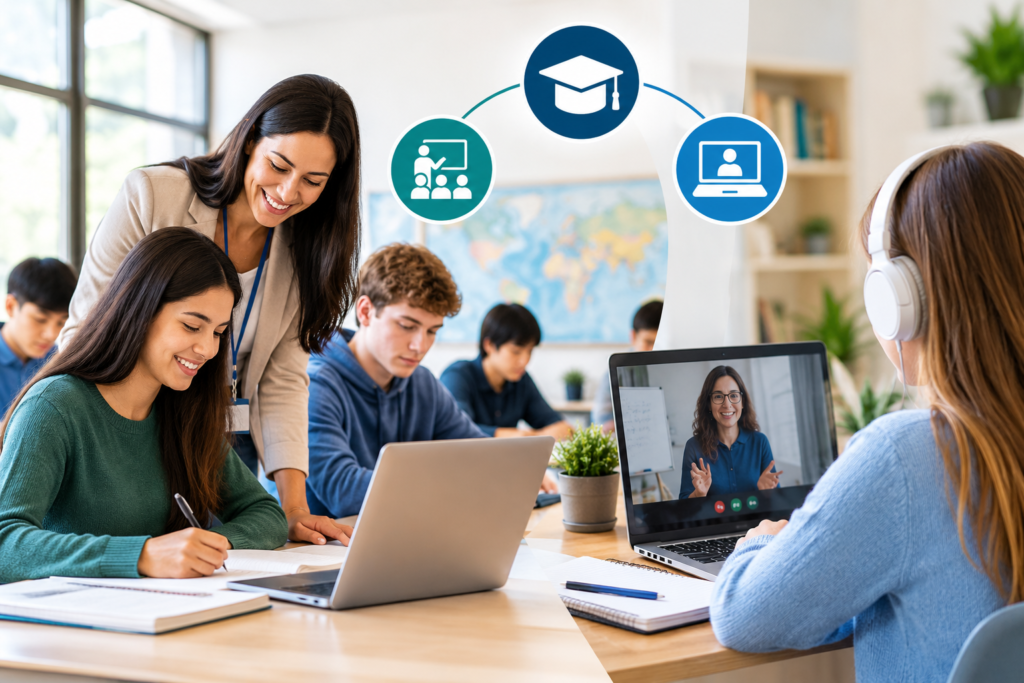
Imagine a school where some students learn in a classroom while others join online. Teachers move between both groups without turning every lesson into a technology problem. Students still have structure, support, and connection, but learning has more flexibility.
That is the promise of a hybrid learning model.
Building one, however, takes more than adding laptops to traditional classes. Schools need a clear purpose, a practical learning format, prepared teachers, reliable technology, and strong student support. The model also needs room to improve as the school learns what works.
What Is a Hybrid Learning Model?
A hybrid learning model combines online and in-person learning as part of one planned educational experience. Students may complete some activities online while attending school for teaching, collaboration, practice, or support.
The exact balance can differ from one school to another. The important point is that the online and in-person parts should work together rather than operate as two unrelated systems.
For some schools, this could mean a regular classroom supported by online learning. For others, it could become a smaller hybrid micro-campus that combines local academic support with digital courses.
Key Takeaways
- Start with the school’s purpose and student needs, not the technology.
- Choose a learning format that teachers and students can realistically manage.
- Build teacher training and student support into the model from the beginning.
- Treat implementation as an ongoing process that needs review and adjustment.
Why Schools Need a Clear Plan
A common mistake is to begin with the question, “Which technology should the school use?”
That question comes too early.
A better starting point is the learning experience the school wants to create. Leaders first need to understand why a hybrid approach makes sense for their students.
Perhaps students need greater scheduling flexibility. Maybe the school wants to expand course choices. It may also want to combine local instruction with online academic programs.
Once the purpose is clear, the school can choose the right school learning model.
Think of it like planning a kitchen renovation. A family would not buy cabinets before deciding how the kitchen needs to work. The same principle applies to a hybrid classroom.
7 Steps to Build a Successful Hybrid Learning Model
Step 1: Define the School’s Purpose
The first step is to identify the problem the hybrid model should solve.
School leaders can review questions such as:
- Which students will the model serve?
- What learning needs are currently difficult to meet?
- Which subjects work well online?
- Which activities require face-to-face support?
- What does the school want students to experience?
The answers create a foundation for the hybrid learning strategy.
For example, a school might want students to access specialized courses that are not available locally. Another school may want a flexible schedule while keeping regular academic support on site.
The model should follow that purpose.
Step 2: Choose the Right Learning Format
There is no single format that works for every school.
Some programs keep most teaching on campus and use online learning for selected activities. Others divide learning more evenly between online and in-person settings.
Schools can also develop smaller hybrid settings. A hybrid micro-campus, for example, can provide a physical learning environment while students complete part of their academic program online.
The right choice depends on student needs, staff capacity, academic goals, resources, and local requirements.
A Simple Planning Framework
Schools can use this five-part framework before launching a program:
Purpose → Format → People → Technology → Review
- Purpose: Define why the model is needed.
- Format: Decide how online and in-person learning will connect.
- People: Prepare teachers, coordinators, and support staff.
- Technology: Select tools that support the planned experience.
- Review: Measure what is working and adjust the model.
This keeps the planning process focused.
Step 3: Design the Student Learning Experience
A hybrid education model should feel like one learning journey.
Students should know what happens online, what happens on campus, and how the two parts connect.
For example, a teacher might introduce a topic during an in-person session. Students could then complete guided online work. The next classroom session could focus on discussion, practice, or feedback.
This approach gives each setting a clear purpose.
Schools should also consider communication. Students need to know where assignments are posted, how they contact teachers, when they attend in person, and where they receive academic support.
Simple routines can make a major difference.
Step 4: Prepare Teachers Before Launch
Teachers are central to successful hybrid learning for schools.
A new platform cannot replace preparation. Teachers need time to understand the learning model and practice using its tools.
Training can cover:
- Planning lessons for online and in-person settings
- Communicating with students digitally
- Managing online assignments
- Providing feedback
- Supporting students who need additional help
- Using technology without allowing it to dominate the lesson
Schools should also give teachers a chance to share what they learn.
One teacher may discover that a particular activity works better online. Another may find that students need more face-to-face guidance. These observations can improve the wider program.
Step 5: Select Technology That Serves the Model
Technology should support the learning plan, not define it.
Schools may need tools for communication, assignments, video lessons, digital resources, student progress, and collaboration.
But more technology does not automatically create better learning.
A useful test is simple:
Does this tool make the planned learning experience easier, clearer, or more accessible?
If the answer is no, the school may not need it.
Technology choices should also consider student access, teacher confidence, technical support, privacy, and local requirements.
Step 6: Build Strong Student Support
Flexibility can help students, but flexibility without structure can become confusing.
Students need clear schedules, instructions, communication channels, and academic support.
Schools should explain expectations before students begin.
A student who knows exactly when to attend, where to find work, how to contact a teacher, and when assignments are due has a much clearer path.
Student support can also include regular check-ins. Teachers and coordinators can identify students who are falling behind and respond early.
Step 7: Start Small and Learn
Schools do not necessarily need to launch a large hybrid program all at once.
A smaller pilot can help leaders understand how the model works in practice.
For example, a school might begin with one grade level, subject area, or limited group of students. Teachers can then observe the experience and identify practical problems.
This can reveal issues that were difficult to see during planning.
Maybe students need more technical support. Perhaps teachers need more planning time. A certain online activity may work well, while another creates confusion.
The school can use those lessons before expanding the program.
A Practical Hybrid Learning Table
| Practice | When it helps | Simple cue | Mistake to avoid |
| Clear weekly schedule | Students need predictable routines | “What happens this week?” | Changing expectations constantly |
| Online preparation | Students need background knowledge | “Learn before class” | Giving students work without guidance |
| In-person practice | Students need feedback or collaboration | “Practice together” | Using classroom time for tasks students could complete alone |
| Digital communication | Students need quick access to information | “Where should students look?” | Using too many communication channels |
| Regular check-ins | Students need academic support | “Who needs help?” | Waiting until problems become serious |
Common Mistakes Schools Should Avoid
Mistake 1: Starting With Technology
Buying platforms before defining the learning model can create unnecessary complexity.
Better approach: Decide what students need first, then select technology that supports it.
Mistake 2: Treating Online Learning as an Add-On
If online work feels disconnected from classroom teaching, students may struggle to see its purpose.
Better approach: Connect online and in-person activities around shared learning goals.
Mistake 3: Underestimating Teacher Preparation
Teachers need time to redesign lessons and become comfortable with new routines.
Better approach: Include training, planning time, collaboration, and ongoing support.
Mistake 4: Giving Students Too Much Freedom
A flexible learning model still needs structure.
Better approach: Provide clear schedules, deadlines, instructions, and regular check-ins.
Mistake 5: Trying to Perfect Everything Before Launch
A school can spend months planning without discovering how students and teachers actually respond.
Better approach: Start with a manageable version, evaluate it, and improve it.
What Does a Hybrid School Model Look Like in Practice?
Consider a school that wants to offer students more course flexibility.
Instead of building a completely online school, leaders create a smaller learning environment. Students attend a local site for scheduled support, community activities, and selected instruction.
They complete other coursework online with guidance from teachers and coordinators.
The school establishes a weekly routine. Students know when they are expected on site and what they should complete online.
Teachers track progress and provide support when students need it.
This is where hybrid school model development becomes more than choosing an online platform. It involves designing the whole experience, from schedules and staffing to student support and evaluation.
How Should Schools Evaluate the Model?
Evaluation should focus on the actual student experience.
School leaders can review:
- Student participation
- Assignment completion
- Teacher feedback
- Technology problems
- Student questions and concerns
- Areas where students need more support
- Teacher workload and planning needs
The goal is not simply to decide whether the model is “good” or “bad.”
The goal is to discover what needs to change.
A strong hybrid learning implementation process allows the model to develop over time.
When Should a School Consider Professional Support?
Schools may benefit from professional guidance when they are unsure how to structure the model, connect academic programs, select an appropriate format, or plan implementation.
Consulting can help leaders assess their current situation and turn broad goals into a practical plan.
For schools considering hybrid school model development, Ferland Global Education Network can support planning around education programs and school model development. Schools should still evaluate their own students, resources, academic goals, and local requirements before selecting an approach.
Conclusion
Building a hybrid learning model is not simply a technology project. It is a school design project.
The strongest starting point is a clear purpose. From there, school leaders can choose a suitable format, prepare teachers, establish student support, select practical technology, and create a process for ongoing review.
A school does not need to solve everything at once.It needs a clear direction, a manageable first step, and a willingness to learn from the experience.
When online and in-person learning are designed to complement each other, schools can create a flexible learning model that fits their students and educational goals.
FAQ
1. What is the main goal of a hybrid learning model?
The goal is to combine online and in-person learning in a planned way. The exact balance depends on the school’s students, goals, resources, and requirements.
2. How much does it cost to build a hybrid learning program?
There is no single cost. Expenses can vary based on technology, staffing, training, facilities, digital resources, and program size. Schools should build a budget around their specific model.
3. Is a hybrid classroom the same as online learning?
No. Online learning can take place entirely online. A hybrid classroom combines online learning with planned in-person experiences.
4. What technology does a school need?
The technology depends on the learning model. Schools may need tools for communication, assignments, digital content, collaboration, and progress tracking. The tools should support the learning plan rather than drive it.
5. When should a school seek professional help?
Professional support can be useful when leaders need help assessing needs, designing a hybrid program, planning implementation, or connecting academic and operational requirements.